
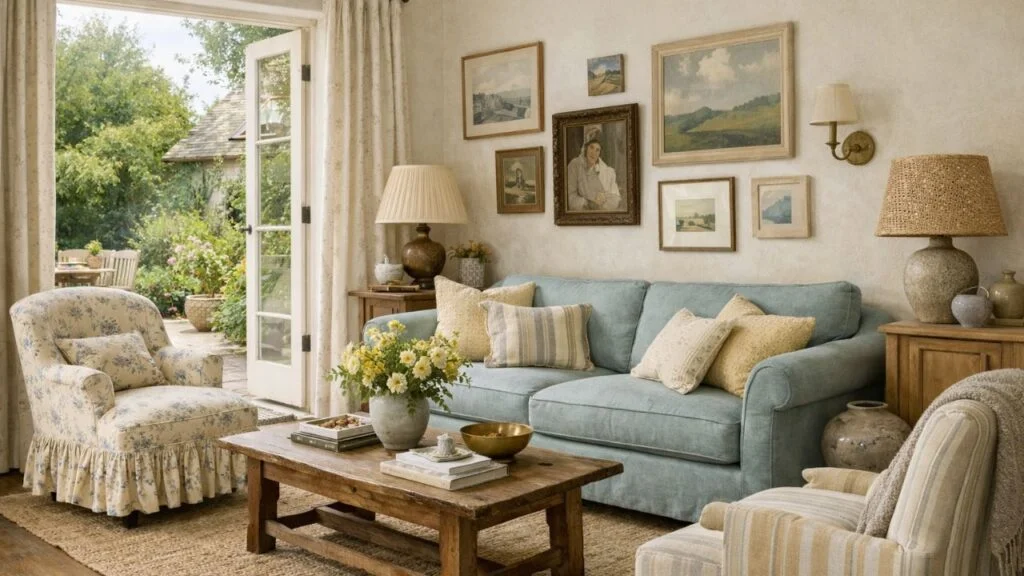
The Return of the English Cottage
There is something enduring about the English cottage.
Not decorative nostalgia.
Not theatrical countryside styling.
But a quieter version—one that feels like it has always belonged to the landscape around it.
Soft plaster walls that hold the day’s light like a gentle echo.
Time-worn wood that looks better for having lived.
Garden brightness filtering through linen curtains, softened by the hush of fabric.
It’s a mood more than a motif.
And today, we’re exploring English cottage interior design through a quiet luxury lens—a way of decorating that doesn’t chase a moment, but refines what’s already timeless.
This isn’t about recreating the past.
It’s about shaping it with restraint.
Taking the warmth and intimacy of the countryside—and letting it become more composed, more architectural, more intentional. A cottage that feels settled, not styled. A home that whispers rather than performs.
Quiet luxury, in its best form, doesn’t remove character. It simply edits until the character feels inevitable.
1. The Architectural Envelope — Where Calm Begins
An English cottage is never just décor.
It begins with structure. The details you can’t “shop” your way into: exposed beams, arched doorways, deep-set windows, built-in shelves, thick walls that make rooms feel held.
In traditional cottage styling, these architectural features often become the stage for more—more pattern, more objects, more charm layered on top. But a quiet luxury cottage lets the architecture lead, then steps back.
Beams remain visible—but not overly stained into contrast. The grain is allowed to soften, to read as honest timber rather than a decorative statement. Walls are plastered smooth, not aggressively textured. Trim stays gentle—more tonal than stark, avoiding high-contrast white outlines that can make a cottage feel graphic instead of grounded.
This is where calm begins: in the envelope.
Quiet luxury also introduces an unexpected principle into cottage design—negative space. There is room between elements. Shelves are not filled to the edge. Corners aren’t forced into “vignettes.” The room isn’t crowded with charm; it’s built on proportion.
It’s a subtle shift, but it changes everything.
Traditional cottage says: add warmth through detail.
Quiet luxury cottage says: let warmth come from structure, and refine what you add.
The cottage breathes.
2. Color — A Muted Countryside Palette
Color in a quiet English cottage feels mineral—like it was mixed from the landscape itself.
Think of soft lilac with grey undertones, butter softened with cream, sage dusted with stone, faded sky blue that looks like it’s been gently washed by light.
These tones are not bright. They don’t demand attention.
They feel aged in the most beautiful way—as if the walls have absorbed decades of daylight, rain, hearth smoke, and summer mornings.
Traditional cottage interiors often leaned into stronger floral contrast: crisp reds, vivid greens, bolder wallpaper moments. Quiet luxury lowers the volume.
Saturation is softened.
Undertones are controlled.
Transitions are seamless.
Instead of a room feeling “decorated,” it feels atmospheric. Colors don’t sit beside each other like blocks; they move like gradients. A warm cream wall melts into a putty-toned trim. A dusty blue cabinet feels like it’s always been there. A muted sage bedroom becomes restful rather than themed.
Color becomes a kind of quiet architecture. It holds the room together without shouting.
If you want the cottage to feel settled, choose colors that feel like they’ve already lived.
3. Furniture — Traditional Forms, Modern Discipline
Furniture in these rooms is unmistakably classic.
A scalloped headboard that nods to heritage without becoming precious.
A wooden bedside table with softened corners.
An upholstered armchair with a slightly rolled arm.
A rustic dining table that looks as if it has hosted years of conversation.
But look closely, and you’ll notice the quiet luxury discipline.
Lines stay clean.
Silhouettes are balanced.
Carving is minimal.
Proportions feel intentional.
A quiet luxury cottage does not stack antiques for effect. It doesn’t create a “collected” look through clutter. It edits, and the editing becomes the elegance.
Instead of five vintage chairs in a corner, you choose one—perfectly placed. Instead of a gallery wall with constant visual movement, you lean into one well-sized piece with breathing room.
Fabric choices matter here, too. Upholstery is quiet: linen blends, cotton, wool, subtle weaves. Nothing glossy. Nothing too precious. The softness is real.
This is the tension that keeps the space relevant: traditional structure, contemporary simplicity.
It’s not about making a cottage modern. It’s about making it timeless.
4. Pattern — Present, But Controlled
Florals are part of English cottage heritage. They belong—like climbing roses and wild hedgerows.
But in a quiet luxury interpretation, florals are softened into something more restrained.
Muted botanical drapery that feels watercolor rather than high-contrast print.
Subtle woven rugs with a whisper of pattern.
Light repetition—small motifs that create rhythm, not noise.
The key is undertone harmony. Patterns share a common palette so they don’t compete. And there is breathing room between motifs. You don’t stack florals on florals on stripes just because you can.
This is where many cottages become overwhelmed. They tip from charming into busy.
Quiet luxury introduces pause.
Layered—yes. But never loud.
If you love pattern, let it live in one primary place per room: the drapery, or the rug, or a single upholstered chair. Then balance it with calm.
The result feels curated, not chaotic.
5. Texture — The Emotional Warmth
In quiet luxury cottage interiors, texture replaces ornament.
Instead of adding more decorative objects, the room deepens through materials:
Linen curtains that soften the window light.
Woven pendants that bring warmth to the ceiling plane.
Natural jute rugs that ground the room without feeling heavy.
Time-worn wood that carries subtle imperfections like a story.
You don’t need excessive styling when materials do the work.
Matte finishes are essential—chalky paint, brushed brass, honed stone, ceramics with soft edges. Touch matters here. The room should feel gentle to live in.
Without texture, cottage can become flat and overly “clean.”
With texture, it becomes lived-in—warm without being cluttered.
Quiet luxury doesn’t mean sterile. It means sensory.
A cottage should feel like you can exhale in it.
6. Art — The Modern Counterbalance
Art is often where this interpretation shifts fully into the present.
Traditional landscapes remain—they belong in a cottage. But now they can sit beside minimal abstracts, soft contemporary compositions, charcoal sketches, or modern photography in understated tones.
This is where quiet luxury becomes powerful: it creates a bridge between past and present.
Art prevents the space from becoming theatrical. It keeps heritage architecture from feeling like a costume.
Frames are restrained—thin wood, soft gold, muted black, or aged silver. Spacing is intentional. One large piece can simplify ornate architecture by giving the eye a place to rest.
And that rest is part of the luxury.
Art introduces quiet tension—the kind that makes a room feel alive, not museum-still. It says: this home respects history, but it belongs to now.
7. Light — Daylight and Shadow
A true English cottage is shaped by light.
Filtered sunlight through gardens and hedges.
Soft shadow in corners.
Evening glow that warms plaster walls like candlelight.
Quiet luxury understands that shadow is not a flaw—it’s dimension.
Lighting becomes layered and gentle:
Pleated shades that soften lamps into halos.
Warm bulbs that mimic sunset tones.
Brass pendants that glow instead of glare.
Woven textures that cast subtle pattern without visual chaos.
Harsh overhead light is the quickest way to flatten a cottage. A quiet luxury cottage avoids that. It builds light like atmosphere, not utility.
Without shadow, a cottage feels flat.
With shadow, it feels cinematic—soft-lit, grounded, and deeply inviting.
8. The Balance Between Nostalgia and Modernity
This is the core of the quiet luxury approach.
Too traditional, and the space feels themed—like a postcard rather than a home.
Too modern, and the warmth disappears—the cottage loses its heartbeat.
Quiet luxury sits between.
Heritage architecture.
Edited styling.
Modern restraint.
Timeless palette.
It’s not a trend. It’s refinement.
This is where the English cottage becomes less about “cottage style” and more about the emotion of cottage living: comfort, intimacy, calm.
The goal isn’t to prove a theme.
The goal is to create a home that feels quietly beautiful on an ordinary Tuesday. A home that’s elegant without ever being precious. A home that feels like it’s been yours for years—even if you’ve just moved in.
10 Common Mistakes to Avoid in a Quiet Luxury English Cottage
- Over-layering pattern.
Florals, stripes, checks, and botanicals all competing at once quickly turn charming into chaotic. - Using high-contrast white trim.
Stark outlines make a cottage feel graphic rather than grounded. - Over-styling shelves.
Filling every inch removes the breathing room that makes the space feel calm. - Choosing overly saturated colors.
Bright reds or sharp greens disrupt the mineral softness of a quiet countryside palette. - Too many small antiques.
A collection without editing reads cluttered instead of curated. - Ignoring negative space.
Quiet luxury relies on pause. Not every corner needs a vignette. - Glossy finishes.
High shine metals, lacquered surfaces, or polished stone fight the matte warmth. - Harsh overhead lighting.
One bright ceiling light flattens depth and removes atmosphere. - Leaning fully into nostalgia.
If everything feels vintage, the space risks feeling theatrical. - Making it “themed.”
Cottage is a mood, not a costume. Subtlety is what makes it timeless.
Video Featuring 100+ English Cottage Style Interior Design Ideas
Closing — A Cottage That Feels Settled
An English cottage does not need excess to feel beautiful.
It needs proportion.
Material honesty.
And thoughtful editing.
When approached through quiet luxury principles, the cottage becomes:
Soft.
Architectural.
Layered.
Calm.
Not styled for a moment—but shaped for a lifetime.
Design slowly. Edit with intention. Let the structure lead. Let texture do the talking. Choose color like atmosphere, not decoration.
And allow the countryside to whisper—not shout.
10 FAQs for about English Cottage Quiet Luxury Design
- What makes an English cottage “quiet luxury” rather than traditional cottage?
It’s the editing. Fewer objects, softer saturation, cleaner lines, and intentional restraint. - Can I mix modern art with traditional cottage architecture?
Yes. Modern art creates balance and keeps the space current without removing warmth. - What colors work best for a quiet cottage palette?
Muted, mineral-inspired tones—sage, dusty blue, warm cream, soft lilac, faded butter. - How do I keep my cottage from looking cluttered?
Introduce negative space. Style selectively. Let architecture lead instead of accessories. - Are florals still appropriate?
Absolutely—but soften them. Choose watercolor-like prints over bold, high-contrast patterns. - What finishes feel most aligned with quiet luxury?
Matte paint, honed stone, brushed brass, natural linen, time-worn wood. - Should everything be antique?
No. Mix heritage forms with contemporary simplicity to avoid feeling staged. - How important is lighting in a cottage interior?
Extremely. Layered, warm lighting creates depth and preserves softness. - Can this style work in a newer home without original beams or plaster?
Yes. Focus on proportion, color harmony, texture, and thoughtful editing. - How do I know when to stop decorating?
When the room feels settled rather than styled. When adding more would only add noise.


